



Industry Trends
Industry Trends
Why is the soft-hard composite board becoming increasingly popular? What advantages does it have compared to traditional PCBs?
Author: BCX
Release Date:2026-06-24
PV:31
With the rapid development of industries such as smart phones, wearable devices, medical electronics, new energy vehicles, and aerospace, electronic products are constantly upgrading towards being thinner, smaller, and more highly integrated. Although traditional PCBs can meet the needs of most electronic products, they are gradually facing challenges in terms of space utilization, structural design, and reliability.
In this context, the rigid-flex printed circuit board (Rigid-Flex PCB) has gained popularity as an important choice for a growing number of high-end electronic products due to its unique structural advantages. So, why has the rigid-flex PCB become increasingly popular? And compared to traditional PCBs, what are its distinct advantages?
What is a soft-hard hybrid board?
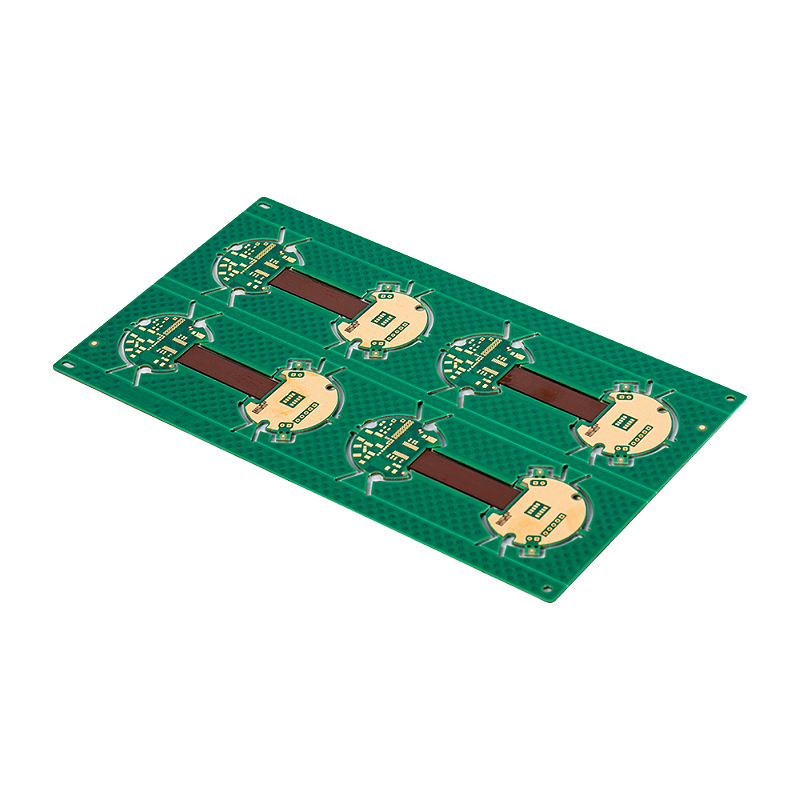
A soft-hard hybrid board is a type of circuit board that connects a rigid PCB and a flexible FPC together through a special process.
In simple terms:
The hard plate section is responsible for component installation and the supporting structure.
The soft panel section is responsible for bending connections and spatial extension.
The two are formed into a complete whole through the laminating process.
Therefore, it possesses both the stability of a hard board and the flexibility of a soft board.
Common structures include:
Two-layer soft-hard composite board
Four-layer soft-hard composite board
Six-layer soft-hard composite board
Multi-layer soft-hard composite board
With the advancement of technology, complex products can even achieve structural designs with more than ten layers.
Why are soft and hard composite boards becoming increasingly popular?
Electronic products are becoming thinner and lighter.
Nowadays, consumers have higher and higher requirements for electronic products.
Not only do we hope for powerful functions, but also:
Lighter
Thinner
Smaller in size
For example:
Smartphone
Smartwatch
Bluetooth headphones
AR glasses
The interior space is extremely limited.
Traditional PCBs usually require:
Connector
Cable assembly
Cable assembly
Realize the connection of different modules.
These structures will occupy a large amount of space.
The soft-hard combined board can directly achieve three-dimensional interconnection.
Effectively save internal space.
The product functions are becoming increasingly complex.
Modern electronic products incorporate a large number of functional modules inside.
For example, a smart phone might contain:
Motherboard
Camera module
Display module
Battery Management System
Antenna system
If the traditional connection method is adopted:
The structure will be extremely complex.
The soft-hard combined board can achieve:
Multi-regional integrated design.
Reduce the overall complexity of the structure.
The requirements for reliability are constantly increasing.
For traditional PCBs and wire connections, the usual procedure is:
Plug and unplug the connector
Welding connection
After long-term use, the following may occur:
Poor contact
Loosen
Oxidation
The soft-hard combined board adopts an integrated structural design.
Reduce the number of connection points.
Significantly enhance the system's reliability.
What are the advantages of the soft-hard hybrid board compared to traditional PCBs?
Advantage 1: Saving installation space
This is the most obvious advantage of the soft-hard hybrid board.
Traditional PCB connection method:
Motherboard
↓
Connector
↓
Cable assembly
↓
Functional Module
The entire connection system takes up a considerable amount of space.
And the soft-hard combined board can directly connect different areas.
Reduce:
Socket
Connector
Cable assembly
Make the product structure more compact.
Therefore, it is widely applied in ultra-thin electronic products.
Advantage Two: Achieving Three-Dimensional Design
Traditional PCBs are of planar structure.
The layout is restricted.
The soft-hard composite board can:
Fold
Bend
Flip
Realize the three-dimensional spatial layout.
For example:
The mainboard inside smart phones often adopts a folded structure.
Make full use of the limited space.
This is something that is difficult to achieve with ordinary PCBs.
Advantage Three: Enhancing Product Reliability
Statistical data show:
A significant portion of electronic equipment malfunctions are caused by connector issues.
For example:
Poor contact
Mechanical wear and tear
Plug-in damage
The combination of soft and hard materials reduces the intermediate connection steps.
Advantages include:
Fewer solder joints
Fewer connectors
Less exposure to malfunctions
Therefore, the reliability has significantly improved.
Especially applicable to:
Medical equipment
Automotive Electronics
Avionics
The field of high reliability.
Advantage 4: Reducing product weight
Traditional PCB with traces:
Usually required:
Connector housing
Metal terminal
Fixed structure
Increase the weight.
The soft-hard combined board integrates multiple components into a single unit.
It can significantly reduce the weight of the product.
Regarding:
drone
Aviation equipment
Wearable devices
Has obvious advantages.
Advantage Five: Enhance Anti-Vibration Capability
Automotive electronics and industrial equipment typically encounter:
High-frequency vibration
Temperature variation
Long-term operation
Traditional connectors are prone to contact problems due to vibrations.
The soft-hard combined board adopts a flexible connection structure.
Capable of absorbing mechanical stress.
Improve system stability.
Advantage 6: Enhance assembly efficiency
The traditional solution requires:
Install the connector
Connector cable
Fixed wiring harness
There are many processes.
The soft-hard composite board can typically achieve:
One installation.
Reduce the assembly steps.
Improve production efficiency.
Reduce labor costs.
Advantage 7: Facilitates High-Speed Signal Transmission
With the development of 5G, WiFi 7 and high-speed data interfaces.
Electronic devices have increasingly higher requirements for signal integrity.
Traditional connectors may bring about:
Change in impedance
Signal reflection
Increased crosstalk
The soft-hard composite board can:
Shorten the transmission path
Reduce the number of connected nodes
Improve impedance continuity
It is conducive to the stable transmission of high-speed signals.
Which industries does the soft-hard composite board mainly apply to?
Consumer electronics
Typical products include:
Smartphone
Tablet computer
Smartwatch
Bluetooth headphones
AR/VR devices
This is the field that is currently the most widely applied.
Medical equipment
Applications include:
Endoscope
Medical monitoring equipment
Ultrasound equipment
Implantable medical devices
High reliability and miniaturization design are required.
Automotive electronics
Main applications:
ADAS system
Vehicle-mounted camera
Intelligent Cockpit
Instrumentation system
Meet the requirements of complex environments.
Aerospace
Aircraft equipment emphasizes:
Lightweighting
High reliability
The combination of soft and hard materials enables the board to significantly reduce its weight while enhancing its stability.
Industrial Automation
Complex control systems increasingly adopt the design of combining hardware and software components.
Improve the utilization rate of space.
Is there any deficiency in the combination of soft and hard materials?
Although it has obvious advantages, it also faces some challenges.
For example:
The manufacturing cost is high.
The process is complex.
The material cost is higher than that of ordinary PCBs.
The design is quite challenging.
It requires considering the following aspects simultaneously:
Rigid board design
Flexible area design
Flexural life
The requirements for design engineers are quite high.
The production cycle is long.
Involves:
Processing of flexible materials
Repeated pressing
Precise alignment
The production process has become more complicated.
The development trend of hybrid boards in the future
In the coming years, the demand for hybrid boards will continue to grow.
The main driving factors include:
AI intelligent terminal For example:
AI glasses
AI wearable devices
New energy vehicles
The autonomous driving system requires a more integrated design.
Medical electronics
The demand for portable medical devices is increasing.
Aerospace and aviation
The demand for lightweighting continues to increase.
Hot News
-
 What application scenarios are high-end HDI boards suitable for? Why are mobile phones, medical equipment and automotive electronics unable to do without them?2026-06-24
 -
 When choosing a manufacturer of high-end HDI boards, what capabilities should be considered? Which one is more crucial among the processes, equipment, and quality control?2026-06-24
 -
 Why is the soft-hard composite board becoming increasingly popular? What advantages does it have compared to traditional PCBs?2026-06-24
 -
 What types of electronic products are the soft-hard composite boards suitable for? What should be noted during the design and production process?2026-06-24