



Industry Trends
Industry Trends
Why is high-density multi-layer board chosen as the option for high-end electronic devices? What are its technical advantages?
Author: BCX
Release Date:2026-06-24
PV:31
With the rapid development of 5G communication, artificial intelligence, cloud computing, new energy vehicles and smart terminals, the integration degree of electronic devices is getting higher and higher, the data transmission speed is getting faster and faster, and the requirements for PCB circuit boards are also constantly increasing. Under such circumstances, high multi-layer boards, due to their excellent performance and strong carrying capacity, have gradually become an important basic component of high-end electronic devices.
From smart phones to AI servers, from medical equipment to autonomous driving systems, an increasing number of high-performance electronic products are adopting high multi-layer boards. So, why are high multi-layer boards the preferred choice for high-end electronic devices? What are the specific technical advantages they possess?
What is a high multilayer board?
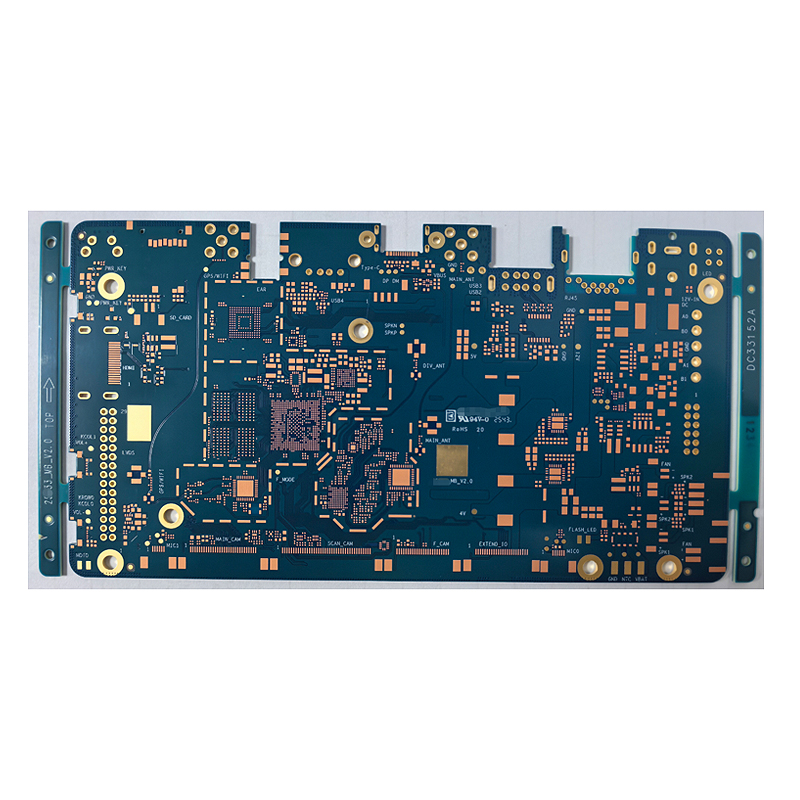
A high multilayer board refers to a multi-layer PCB with a large number of layers, a complex structure, and high processing requirements.
Generally speaking:
PCB above the 10th layer
PCB above the 12th layer
PCB above the 16th layer
It is usually referred to as a high multi-layer board.
Some high-end products even reach:
24th floor
32th floor
Above the 40th floor
Compared with ordinary 4-layer boards and 6-layer boards, high multi-layer boards have more conductive layers and signal layers, enabling more complex circuit designs and higher density of electronic integration within a limited space.
Why are high-end electronic devices increasingly relying on multi-layer boards?
The development trend of electronic products mainly focuses on three directions:
More and more functions
The volume is getting smaller and smaller.
The computing speed is getting faster and faster.
These three directions precisely impose higher requirements on PCBs.
Ordinary multi-layer boards are gradually approaching their limits in terms of wiring capacity, signal integrity and system stability, while high multi-layer boards can effectively address these issues.
Therefore, it has become an important choice for high-end electronic devices.
Technical Advantage 1: Provides more wiring space
High-end electronic products usually integrate a large number of components inside.
For example:
An AI server motherboard may contain:
CPU
GPU
FPGA
High-speed memory
Network switching chip
There is a need for a large number of signal connections between these devices.
If an ordinary PCB is used:
The line capacity will soon be insufficient.
And the high multi-layer board can significantly enhance the wiring capability by increasing the number of conductive layers.
For example:
PCBs of the same size,
The 16-layer board can offer a much higher wiring capacity than the 6-layer board.
This enables the satisfaction of the design requirements for complex systems.
Technical Advantage 2: Enhance Signal Transmission Performance
Modern electronic devices increasingly rely on high-speed data transmission.
For example:
DDR5 memory
PCIe 5.0
PCIe 6.0
USB4
800G optical module
These high-speed interfaces have extremely high requirements for PCB signal integrity.
The high-density multi-layer board can:
Shorten the signal path
Optimize the reflux channel
Reduce crosstalk
Reduce reflection loss
This ensures the stable transmission of high-speed signals.
For servers and communication devices, this is an indispensable capability.
Technical Advantage 3: Better Impedance Control Capability
During high-speed signal transmission:
The discontinuity of impedance is likely to cause:
Signal reflection
Data error
Communication interruption
The high multi-layer board can achieve the following through a reasonable layering design:
50Ω single-ended impedance
90Ω differential impedance
100Ω differential impedance
And keep the error within a relatively small range.
This is for:
Data Center
Network equipment
Communication base station
It is of great significance.
Technical Advantage 4: Enhanced Power Integrity
High-performance chips have increasingly higher requirements for power supply quality.
For example:
When AI chips are in operation, they generate significant transient current fluctuations.
If the power supply system is not designed properly:
容易出现:
Voltage fluctuation
Noise interference
System crashed
High-density multi-layer boards can incorporate dedicated power layers and ground layers.
Form a stable power supply network.
Advantages include:
Reduce power supply noise
Improve power supply stability
Reduce electromagnetic interference
This will thereby enhance the overall system performance.
Technical Advantage 5: Enhancing Electromagnetic Compatibility Performance
As the operating frequency of the equipment continues to increase:
The problem of electromagnetic interference is becoming increasingly prominent.
The high multi-layer board can be used for:
Complete graphic design
Reasonable stacking structure
Power isolation design
Effectively suppress electromagnetic radiation.
At the same time, reduce the impact of external interference on the equipment.
Regarding:
Medical equipment
Communication system
Industrial automation equipment
This advantage is particularly important.
Technical Advantage 6: Support for Higher Integration Design
High-end electronic products generally pursue:
Miniaturization
Lightweighting
Multifunctional
For example:
The interior of a smart phone needs to integrate simultaneously:
Communication module
Video camera system
Storage system
Power Management System
The space is extremely limited.
The high-density multi-layer board can complete complex wiring within a limited area.
Achieve more functional integration.
Therefore, it has become an important choice for high-end consumer electronics.
Technical Advantage 7: Enhancing System Reliability
The high multi-layer board not only focuses on performance.
Emphasizes long-term stable operation.
Through reasonable design:
Can be achieved:
More uniform heat distribution
Greater mechanical strength
Better vibration resistance capability
It is particularly important for the following areas:
Automotive Electronics
Medical equipment
Industrial Control
Aerospace and Aviation
These industries usually require the products to operate continuously for a long period of time.
Reliability is far more important than cost.
What high-end electronic devices mainly use high-density multi-layer boards?
Communication equipment
Including:
5G base station
Optical communication equipment
Core Switch
High-end router
These devices need to handle massive amounts of high-speed data.
The high-density multi-layer board can meet its high-speed transmission requirements.
AI servers and data centers
AI training servers usually require:
Multiple CPUs
Multiple GPUs
High-speed memory system
A large number of high-speed signals require stable transmission.
Therefore, a high multi-layer board design is widely adopted.
New energy vehicles
Applications include:
Autonomous Driving Domain Controller
Intelligent Cockpit System
Battery Management System
Vehicle-mounted communication module
These systems require high-reliability PCB support.
Medical equipment For example:
CT equipment
MRI equipment
Ultrasound diagnostic system
Life monitoring equipment
The high multi-layer board can ensure signal accuracy and system stability.
Industrial automation equipment
Modern industrial control systems are becoming increasingly integrated.
Complex data collection and control tasks need to be handled.
High-density multi-layer boards have become an important hardware foundation.
The future development trend of high multilayer boards
As electronic technology continues to upgrade, high multilayer boards are evolving in the following directions:
Higher levels
Future:
Above the 30th floor
Above the 40th floor
The product will become more widespread.
Higher speed
Support:
PCIe 6.0
PCIe 7.0
224G high-speed transmission
Be designated as a development priority.
Higher integration
Combined with HDI technology.
Realization:
High level of hierarchy
High density
Dual advantages.
Lower-loss materials
Satisfy:
AI Computing
6G Communication
High-performance network equipment
Requirements.
Hot News
-
 Why are high-level HDI boards often used in high-end electronic products? What are the differences between them and ordinary PCB boards?2026-06-24
 -
 Why are the costs of high-level HDI boards relatively high? What are the factors influencing the quotations?2026-06-24
 -
 What should be taken into account when designing high-level HDI boards? How to consider the stack-up structure and signal stability?2026-06-24
 -
 Is it better to have more layers in a high-density multi-layer board? What issues should be considered during design and manufacturing?2026-06-24